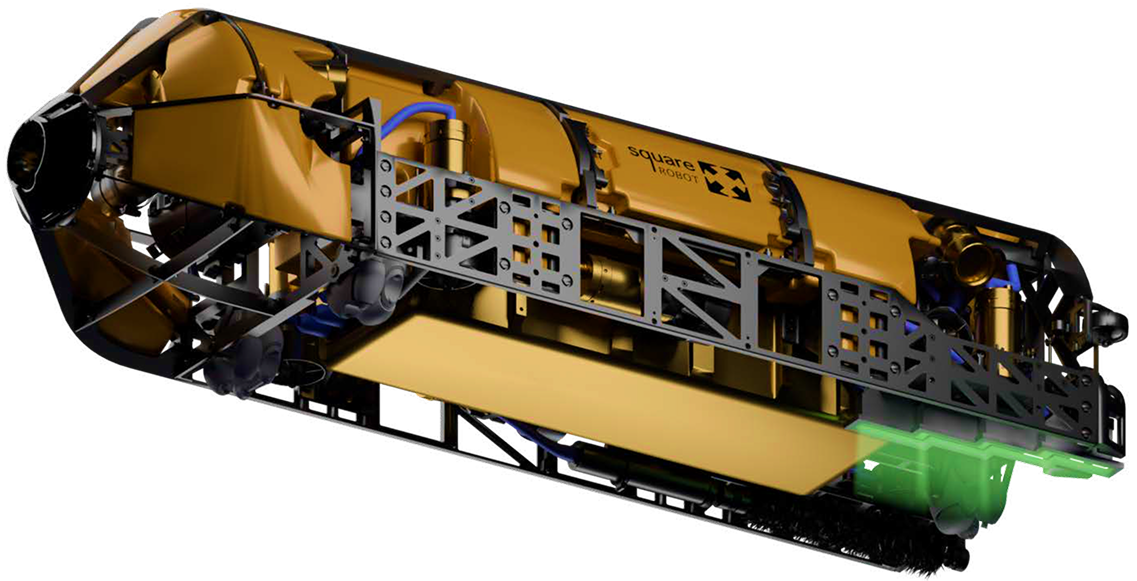
The SR-3
On 24 and 25 September 2026, Square Robot brought together tank owners, inspection leaders, regulators, partners and industry bodies at Hotel Baía in Cascais, Portugal, for two days on one question: what does the future of robotic tank inspection look like, and what will it take to get there?
The answer that came out of the room was clear. Robotic, in-service inspection is no longer an experiment. Operators are using it at scale, regulators are starting to write it into the rules, and the conversation has shifted from "does it work?" to "how do we standardize, trust and act on the data?"

The seminar drew a focused group of the people who own, inspect and set the rules for Europe's and North America's storage tanks. Asset owners and operators included TotalEnergies, ExxonMobil, Shell, Vopak, Galp Energia, Marathon Petroleum, Eni and Advario, among others.
They were joined by EEMUA (the Engineering Equipment and Materials Users Association), and inspection and engineering specialists, as well as partners from Groupe Institut de Soudure, END Tecnologia and Sutro Group. Tank Storage Magazine attended as media partner.
That mix mattered. Having the people who run tank fleets sit next to the people who write the guidelines meant the discussion stayed practical: what the rules allow today, what operators need next, and how to close the gap.

Day One focused on the frameworks that decide whether robotic inspection can replace traditional out-of-service work, and what operators must check before a robot goes into a tank.
Changing the rules in France. Franck Clement, Corporate Inspection Expert at TotalEnergies, walked through how the company worked with French authorities to update DT94, the national guideline for storage tank inspection. TotalEnergies runs 5,000 to 7,000 tanks worldwide and did its first ROV internal inspection in 2017. The draft update adds a new annex that recognizes robotic, in-service internal inspection, both as fresh data for risk-based inspection and, with high coverage and qualified systems, as a replacement for some traditional inspections. His advice to other operators: build a safety case the regulator can audit, anchor it in recognized standards, and remember that "one mistake can delay the deployment."

How guidelines drive innovation. John Verduijn, Manager Inspection at Vopak and Chair of the EEMUA Storage Tank Committee, traced the evolution of EEMUA 159 across six editions. The 2025 edition now includes guidance on submerged floor-scanning robots and drones. He also introduced EEMUA 247, the first guideline for partial-coverage robotic floor inspection. It uses proven statistical methods (Extreme Value Analysis) to draw conclusions about areas a robot does not scan. His point: guidelines written by operators, for operators, can turn new technology into accepted, defensible practice.

Trust, but verify. Katie Aho, PhD, Senior Regulatory Compliance Engineer at Square Robot, covered what operators need to know about hazardous location certification for robots working in flammable atmospheres. She explained how to read Ex markings, how to check a certificate in the issuing body's public database, and common red flags, such as component-level certificates presented as system certification. Her bottom line: verification is the tank operator's control, and deployment should not proceed on a verbal assurance.

Reaching the blind spots. Nicolas Nourrit, Engineering and Expertise Director at Groupe Institut de Soudure, presented two developments. The first, MargIS, uses phased-array ultrasonics from outside the tank to detect corrosion under the annular plate near the shell-to-bottom weld, while the tank stays in service. A pilot on a TotalEnergies tank matched metallurgical cuts closely, and the method is now in a French industry guide. The second is a joint effort with Square Robot to adapt robotic PAUT to inspect the chime corner weld from inside an in-service tank. Operators were invited to join the next phase of testing.

Day Two moved from rules to results: how operators turn in-service data into integrity decisions, and where the technology goes next.
Scaling tank integrity at Galp. David Rodrigues, Inspection Engineer at Galp's Sines Refinery, shared how Galp built its integrity program. The case for robotics starts with tank availability. On three tanks, a conventional outage took 431, 252 and 181 days, compared with 11, 2 and 1 day for a robotic inspection. Galp completed a proof of concept on five representative tanks in 2026 and will begin rolling the program out across eligible tanks in 2027. His key lesson: "the robot performs the inspection; the integrity program turns the result into a decision."

Where robots fit in integrity management. Peter Kerkhof, independent consultant and former Shell integrity specialist, looked at when in-service inspection makes sense. Good candidates include tanks believed to be in good condition, tanks tied directly to process units, and sites with limited tankage. Tanks with known leaks or a history of heavy corrosion are usually better handled out of service. He shared an example where in-service inspection of 35 tanks moved about half to a lower likelihood ranking, freeing attention for the tanks that needed it most. He also suggested pairing robotic data with non-intrusive methods such as acoustic emission to build more confidence in the results.

EVA and RBI in practice. Mark Stone, VP of Data and Analytics at Square Robot, explained how in-service phased-array ultrasonic data and Extreme Value Analysis feed risk-based inspection under EEMUA 159 and API 581. Robotic PAUT records thickness at every point scanned, not just the deepest features above a threshold. Where coverage is partial, EVA gives an estimate of the floor's minimum thickness along with its uncertainty. Those outputs can then drive remaining-life and next-interval decisions under both traditional and RBI approaches.

What subsea can teach tanks. David Lamont, CEO of Square Robot, closed with a look ahead. Subsea operators solved many of the same problems years ago: no draining, no human entry, no dry dock. Methods proven offshore, such as simulator-based pilot training, robotic cleaning, coating, composite wrapping and friction welding, are ready to move into tanks. He described a future "resident" robot that lives in the tank, charges at a side launcher, and runs regular floor, shell and weld scans. His view: the technology already exists, and taking tanks out of service should become the exception.

A few themes ran through both days:
Thank you to every company, speaker and partner who joined us in Cascais. The conversation doesn't end here. If you'd like to learn more about in-service robotic inspection, or talk about what it could mean for your tank fleet, get in touch with our team.