The SR-3
Reviewed by a Square Robot API 653 Certified Inspector. Last updated July 2026.
On-stream (in-service) tank inspection assesses a storage tank while it stays full and in operation, whereas out-of-service inspection requires emptying, cleaning, and entering the tank first. Both can support API 653 compliance. They differ sharply in cost, downtime, safety, and the type of data they produce, which is why the choice matters for every tank in your program.
If you own aboveground storage tanks, understanding what makes a good tank candidate for a robotic, on-stream inspection vs which should be taken out-of-service can increase site efficiency, impacting the dollar line. This guide lays out how the two methods actually compare and how to decide between them.
Out-of-service inspection is the traditional approach. The tank is removed from service, de-inventoried, degassed, cleaned, and made safe so inspectors can enter the confined space and examine the tank internals. This method is most widely used and accepted across tank operators, with the inception of using Magnetic Flux Leakage systems (MFL) coming to the industry in the 1960s. With this process, the floor is surveyed for expected corrosion, areas marked, and then measurements taken with spot ultrasonic readings. This practice is logical for tanks that have known corrosion needing repairs.

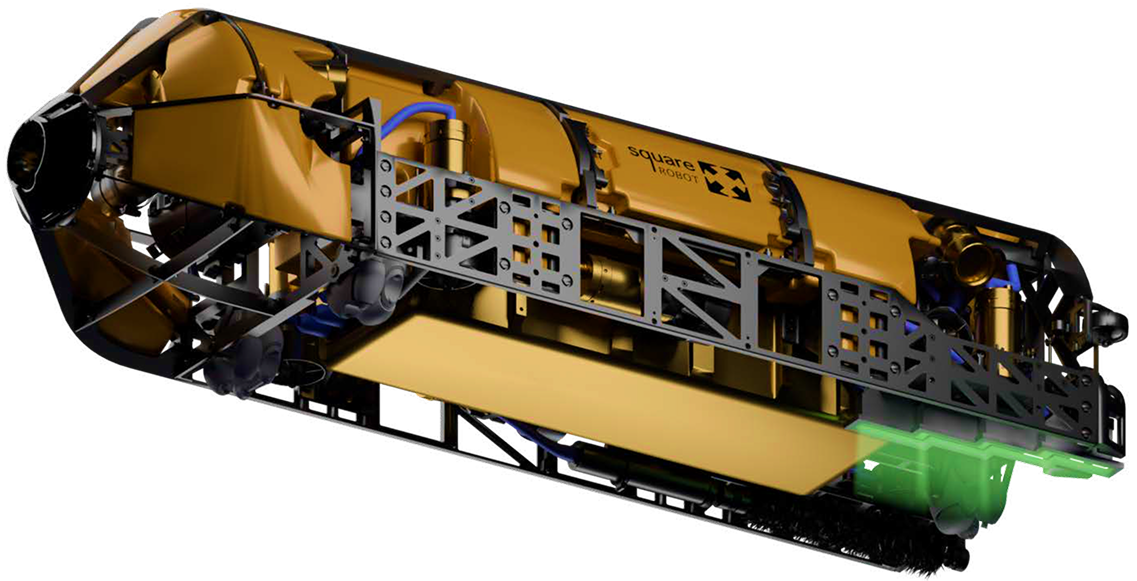
On-stream inspection uses a robot that operates inside the tank while it remains full. Square Robot's SR-3 platform is deployed through an existing opening, moves across the floor submerged in product, and captures high-density phased-array ultrasonic (PAUT) data. Instead of the initial survey that happens with MFL, Square Robot uses its PAUT to scan and measure the entirety of the tank bottom that it covers. For the full mechanics, see our guide on what robotic tank inspection is.

On-stream is almost always cheaper per inspection, because the biggest cost of the traditional method is not the inspection itself. It is the lost production while the tank is offline plus the cleaning, degassing, and waste disposal. Model your own figures with the Value Calculator.
On-stream inspection is not a universal replacement. An out-of-service outage is still appropriate when the tank needs physical repair or recoating, when a code-required check can only be completed with entry, or when the tank must be opened for other turnaround work anyway. The smart pattern for most operators is to use frequent on-stream inspections to monitor floor condition and to schedule out-of-service events on evidence rather than on a fixed calendar. That way you enter a tank when the data says it is time, not before.

Yes. API 653 recognizes alternative inspection methodologies, and high-density robotic floor data is an accepted way to determine corrosion rates and set the next inspection interval without personnel entry. Reports must still be produced by certified API 653 inspectors. See our certifications for the underlying credentials, and our on-stream inspection services for how reporting is delivered.
The discussion around “what are you actually seeing or measuring” in the tank has been around since inspectors were using pit gauges. Tank operators want assurances that the inspection being performed is going to cover all of the tank internals, often termed “100% coverage.” Whether the inspection is performed out-of-service or on-stream, limitations always have to be evaluated.
Out-of-service inspections satisfy a real and legitimate need: having a qualified inspector's eyes directly on the internals of a tank. But that same reliance on a human operator is also where the method's biggest vulnerability lives. The industry's working assumption is that MFL delivers 100% coverage across a tank bottom — in practice, that's only true when the inspector running the scanner is disciplined about multi-directional passes, careful about overlap, and fluent enough in the technology to recognize when the data itself is degrading. When that level of rigor isn't there, corrosion gets missed, and the inspection report says "100% coverage" regardless.
MFL inspection works on a fairly simple physical principle. A scanning head carries strong magnets, arranged in a yoke with the poles on either side of an array of sensors, and drives the steel plate into a high level of magnetic saturation — the plate is carrying about as much magnetic flux as it can hold. In a plate with no metal loss, that flux stays contained and flows smoothly from one pole to the other. Where a defect reduces the plate's cross-sectional thickness — a corrosion pit, general wall loss, or pitting from either the top or bottom surface — the remaining steel can't carry the same flux density, so some of it leaks out through the surface. That's the leakage the technique is named for, and it's picked up by Hall-effect or coil sensors riding just above the plate between the magnet poles. Signal strength and shape correlate roughly with defect size and depth, though MFL is best understood as a screening and detection tool rather than a precision-sizing one, which is why it's typically paired with ultrasonic thickness (UT) verification.
Welds are one of the classic places where that screening tool loses its footing, and where inspector skill matters most:
The bottom line: getting a genuinely complete, reliable read on a tank bottom this way requires an inspector who is scanning in multiple directions with deliberate overlap, and independently validating every weld, column, and internal structure with ultrasonics — a slow, manual, and inherently variable process. Skip any of that, and there will likely be areas of the tank bottom that go unchecked without anyone knowing it.
Robotic inspection removes the tank from service entirely from the equation — no draining, no cleaning, no confined-space entry, no downtime — and it removes a good deal of the human-variability problem along with it. A platform like Square Robot's SR-3 performs survey and measurement in a single pass, collecting roughly 10,000 UT readings per square foot: a resolution density that simply isn't achievable with a manual, step-by-step process, and one that isn't dependent on any one operator's technique or fatigue level on a given day. The robot's navigation is logged and repeatable, so coverage is systematic rather than a function of how thorough a particular inspector chose to be.
That said, in-service inspection has its own real, well-understood factors that affect coverage, and they're worth stating plainly:
Even accounting for those factors, the comparison tends to favor the robot decisively. Because the SR-3 is capturing survey and measurement together, at a data density no manual method approaches, a straight coverage-percentage comparison undersells the difference. In tanks with minimal internals — say, a single center column — the SR-3 has achieved up to 98% coverage of the tank bottom in a single in-service pass. In tanks with more columns and internal structure, operators can pair the inspection with an extreme value analysis to statistically extrapolate the estimated lowest remaining thickness in the small areas the robot couldn't physically reach — turning a handful of known, well-documented gaps into a defensible engineering estimate, rather than an unknown risk sitting inside a report that claims 100% coverage.
Put together: robotic in-service inspection trades a small, well-characterized set of coverage exclusions — clearly mapped, clearly explained, and statistically bounded — for the elimination of tank downtime, confined-space risk, and the inspector-to-inspector variability that makes "100% MFL coverage" an aspiration more often than a fact.

Ask questions for each asset.

Explore deployments across sectors under industries we serve.
It is an inspection performed while the tank remains full and in operation, typically using a robot that scans the floor with ultrasonic sensors. No draining, cleaning, or confined-space entry is needed.
For floor and lower-shell conditions, high-density robotic ultrasonic data can be more complete than the spot readings taken during many manual inspections. Out-of-service entry is still needed for direct repair or certain visual checks.
It can satisfy the data and interval requirements for tank-bottom assessment under API 653 and, within a risk-based program, can defer or extend out-of-service events. It does not replace outages needed for physical repair.
On-stream is usually far cheaper, because it avoids lost production, cleaning, degassing, and waste disposal, which are the dominant costs of taking a tank offline.