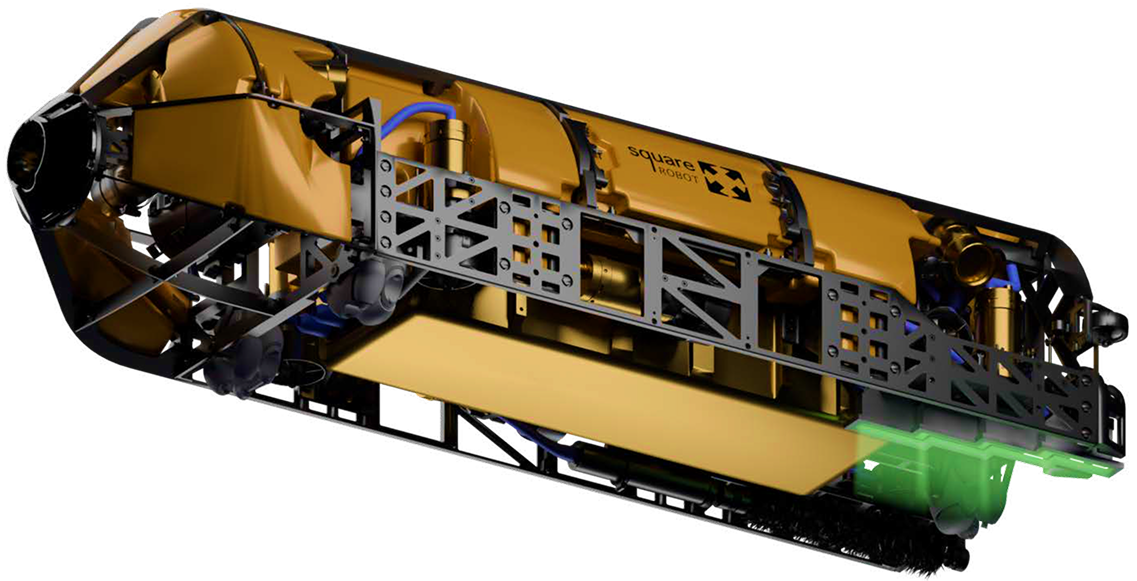
The SR-3
Reviewed by a Square Robot API 653 Certified Inspector. Last updated July 2026.

Robotic tank inspection is the use of an autonomous or remotely operated robot to inspect the inside of an aboveground storage tank, most often the tank bottom and shell. These robotic inspections can be done while the tank is out-of-service, or while the tank remains in service, providing the benefit of no draining, cleaning, or sending personnel into confined spaces. For this in-service deployment, which is how Square Robot operates, the robot is deployed through an opening in the tank, moves across the floor while submerged in product, and captures high-density ultrasonic thickness data used to assess corrosion and satisfy standards such as API 653.
For decades, inspecting a tank's floor meant taking it out of service. That involved emptying tens of thousands of barrels, degassing, cleaning, and sending inspectors into a hazardous enclosed space for days or weeks. On-stream robotic inspection changes that equation. This guide explains exactly how it works, what it can and cannot do, how it meets API 653 and EEMUA 159 standards, what it costs relative to the traditional approach, and how to decide whether it is right for your tanks.
Quick answer. A robot enters the tank through a roof or shell opening, navigates the floor while the tank stays full and operational, scans the tank bottom with a 256 element phased-array ultrasonic sensor to map thickness and corrosion, collects high resolution visuals through two onboard cameras, and measures elevation of the tank bottom to provide the industry’s only on-stream tank settlement analysis. Certified inspectors then turn that data into a compliant report meeting API 653 and EEMUA 159 requirements.
The process has four stages.

The robot enters through a 24 inch tank manway, either through the roof or tank shell, using the necessary deployment equipment needed for the launch. Because it operates submerged in the stored product, the tank does not need to be emptied or cleaned first. There is no scaffolding, no tank entry permit, and no confined-space rescue standby.
Once on the floor, the robot moves in a controlled pattern across the tank bottom. Square Robot's SR-3 platform uses patented autonomous navigation to position itself and return corrosion readings to within a six-inch radius of a known location. That accuracy matters enormously when you later need to re-inspect the same spot or plan a repair.
The robot has a 256 element phased-array ultrasonic testing (PAUT) probe. Modern systems use ultrasonic elements to scan tank bottoms at high density, collecting floor thickness at the same time as floor settlement data. Square Robot simultaneously measures PAUT data and differential elevation to produce tank bottom settlement readings accurate to 1/4th of an inch. This produces a far more complete picture than spot-checking magnetic flux leakage (MFL) sweeps during out-of-service inspections, which only provides wall loss readings on the areas that were spot checked with ultrasonics. Square Robot provides tank bottom wall loss measurements across all accessible areas, delineating between product side and soil side corrosion.
Raw data alone is not compliance. Square Robot uses its team of certified NDT Level 3 analysts and API 653 inspectors to analyze, review and then issue a report aligned to either API 653 or EEMUA 159. Reports often include an Extreme Value Analysis to statistically estimate the worst-case corrosion across the floor. See how this is delivered end to end on our on-stream inspection services page.
Quick answer. Traditional inspection requires taking the tank offline. Robotic on-stream inspection keeps it working. The difference shows up in cost, time, safety, and data.
Independent industry sources put the financial benefit of on-stream robotic inspection at anywhere from hundreds of thousands to millions of dollars per tank versus a traditional out-of-service internal inspection, once you account for lost throughput, cleaning, and waste disposal.
Quick answer. Yes. API 653 recognizes the use of alternative inspection methodologies, and robotic PAUT data is an accepted way to assess tank-bottom condition without personnel entry. Per API 653 section 6.4.1.2
This is the question that decides most purchases, so it is worth being precise. API 653 is the American Petroleum Institute standard governing inspection, repair, alteration, and reconstruction of aboveground storage tanks. It sets requirements for internal inspection intervals and for determining minimum floor thickness and corrosion rates. Robotic in-service inspection supports compliance in two ways.
The credibility of that data depends on the provider's certification and detection performance. Across 400+ tanks inspected, Square Robot's multi-year study demonstrated PAUT sizing that surpassed API 653 Annex G expectations, reaching 99.6% confidence, and reports are produced by certified inspectors following API 653, EEMUA 159, and Extreme Value Analysis under API 581 and EEMUA 247. See our certifications for the underlying credentials.
The value of an inspection is the quality of the decision it enables. A partial floor scan can miss localized pitting. A high-density scan builds a near-complete thickness map. That map does three things: it improves the accuracy of remaining-life estimates; it establishes a repeatable baseline so future inspections can measure true corrosion rate rather than a single snapshot; and it feeds Extreme Value Analysis to statistically estimate the worst corrosion you did not directly measure. Over multiple cycles, this lets operators build a genuine lifecycle database for each floor, something that is impractical when a tank is only opened once a decade.
Manual internal inspection exposes workers to one of the most hazardous environments in industry. It is an enclosed, potentially oxygen-deficient or flammable space with residual product and sludge. Robotic inspection removes the person from that environment entirely. Across its programs, Square Robot reports more than 236,000 confined-space hours eliminated, which is time no worker had to spend inside a tank. For an HSE manager, that is not a convenience. It is a category of risk and liability removed from the job, and it is often the single strongest internal argument for adopting the approach.
There is no single sticker price, because cost depends on tank size, product, access, and scope. But the ROI logic is consistent. The robotic inspection fee is compared against the fully loaded cost of taking a tank out of service. That traditional cost includes lost production while the tank is offline, product removal and temporary storage, cleaning and degassing, waste disposal, and the labor and safety overhead of confined-space work. When those are added up, keeping the tank online usually wins decisively. Across its programs, Square Robot reports more than $170M in downtime avoided. To model your own numbers, use the interactive Value Calculator.
Robotic in-service inspection is designed for aboveground storage tanks across the sectors that depend on them, including refining, petrochemical and chemical, midstream terminals, aviation fuel, power generation, mining, and renewables. Suitability depends on factors like tank construction, product, floor obstructions, and available openings. The best first step is a compatibility check against the platform. See the tanks and sectors covered under industries we serve and real deployments in our case studies.
Robotic inspection is not a universal replacement for every out-of-service activity. It focuses on inspection data, so it does not perform physical repairs, coating, or cleaning. Some tank geometries, internal structures, heavy sludge, or product types can limit access or coverage, and certain code-required checks may still call for an eventual internal entry.
The right framing is that robotic inspection defers and optimizes out-of-service events by giving you the data to schedule them on evidence rather than a fixed calendar, and in many cases it extends the safe interval significantly. A reputable provider will tell you where the limits are before mobilizing.
Preparation is light compared to a shutdown, but a few things speed the job. Confirm an appropriate deployment opening is available. Share tank drawings and construction details. Provide product and level information. Identify known internal obstructions.
Your provider handles deployment logistics and permitting for the operation itself. For document requirements, our technical documents outline compatibility and data specifics.

Evaluate providers on five things.
A provider that can show first-party performance data, not just marketing claims, is the safer choice.
Yes. API 653 recognizes alternative inspection methodologies, and robotic phased-array ultrasonic data is an accepted way to assess tank-bottom condition and corrosion rates without personnel entry, provided the work is performed and reported by certified inspectors.
Yes, and that is the core advantage. The robot operates submerged in the stored product, so the tank stays full and online during the inspection. No draining, cleaning, or degassing is required beforehand.
Typically days, versus the weeks or months a traditional out-of-service inspection can require once you include emptying, cleaning, and returning the tank to service.
Primarily the tank bottom plates and the critical zone, capturing thickness, corrosion, and settlement data. Some platforms, including Square Robot, can also scan the tank shell either from the internal or external.
API 653 sets internal inspection intervals that can be based on measured corrosion rates or a risk-based inspection assessment (Ref. API 653 section 6.4.2.1 to 6.4.2.1.2). High-density robotic data supports determining the correct interval, and can justify extending it where the evidence allows, rather than defaulting to a fixed date.
Aboveground storage tanks used in refining, chemical, terminals, aviation, power, mining, and renewables. Suitability depends on tank construction, product, and access, which a provider verifies with a compatibility check.
Robotic tank inspection is not just a safer version of the old job. It changes when and whether you have to take a tank offline at all. By capturing high-density tank data while the tank stays in service, it removes confined-space risk, avoids the large cost of a shutdown, and gives integrity teams better data to make decisions. If you are weighing it for your assets, model the savings with the Value Calculator or talk to our team about a compatibility review.